
The fastest way to reduce event costs is to decide what your attendees will actually remember, fund that, and stop paying for everything else, including the fees that quietly eat into every ticket you sell. Venue, food and production are where most savings come from. Ticketing and event website costs are the line most organizers never question, and it is the easiest to fix: with Actickety you build your event site and set up ticketing for free, pay nothing upfront until you go live, and pay no platform fees on ticket sales.
TL;DR
- Build a break-even budget before you book anything, and track estimates against actual spend as invoices arrive.
- Protect the moments attendees remember (content, smooth entry, a warm welcome) and cut décor, giveaways and printed extras.
- Choose off-peak dates, negotiate food and beverage inside the venue contract, and bundle work with suppliers.
- Hold back at least 10% of the budget for last-minute needs.
- Stop paying platform fees on ticket sales: your ticketing setup is a cost line you control.
Table of Contents
- Start with a budget that shows break-even
- Spend on the moments people remember
- Lower venue and supplier costs
- When virtual or hybrid cuts costs
- The cost most organizers never question: ticketing
- Control attendance, cancellations and last-minute spending
- Measure value, not only profit
- Perspective
- Build your event page without upfront costs
- FAQ
- Sources
Start with a budget that shows break-even
You cannot cut costs sensibly without knowing which ones matter. A professional budgeting guide from Southland New Zealand recommends a preliminary budget that projects revenue, expenses and break-even: the number of tickets you must sell before the event stops losing money. It also advises getting supplier quotes, separating fixed costs from variable costs, and planning for more than one ticket-sales scenario.
Here is what that means in practice.
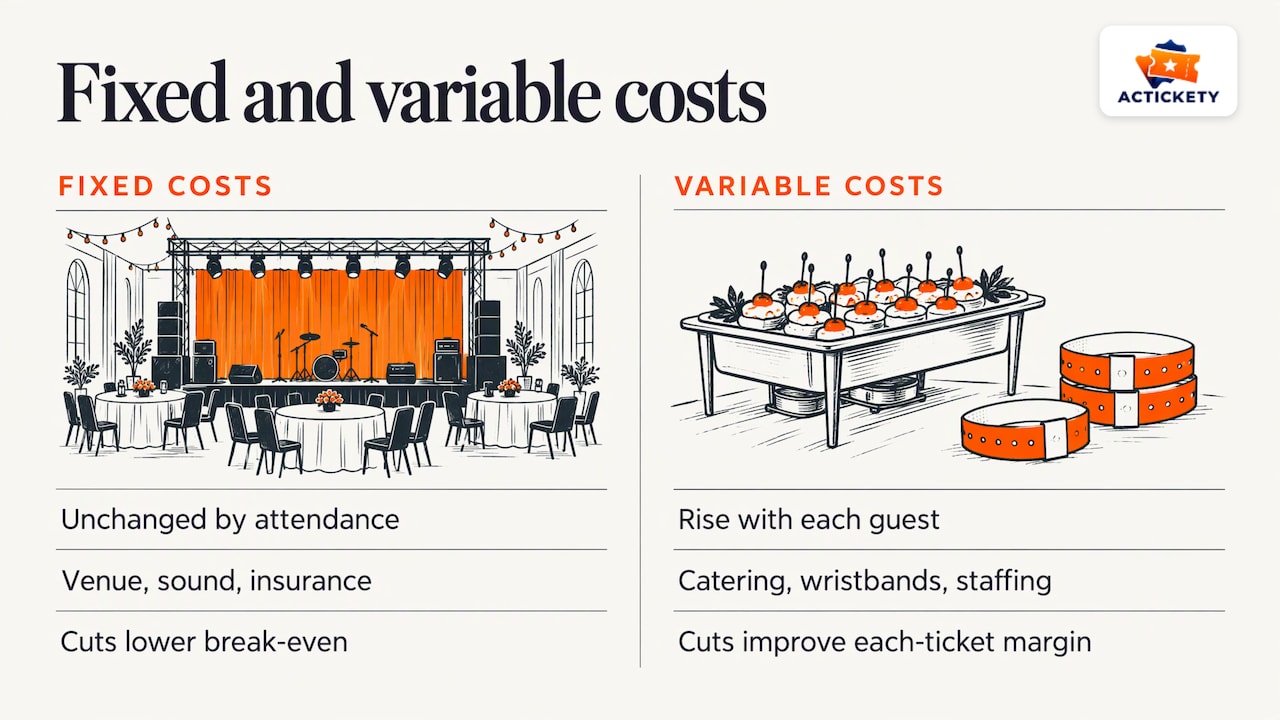
Fixed costs do not change with attendance: venue hire, sound and lighting, insurance, permits, your website. Variable costs rise with every guest: catering, wristbands, printed programs, staffing ratios. Reducing fixed costs lowers your break-even point. Reducing variable costs improves your margin on every extra ticket.
A worked example
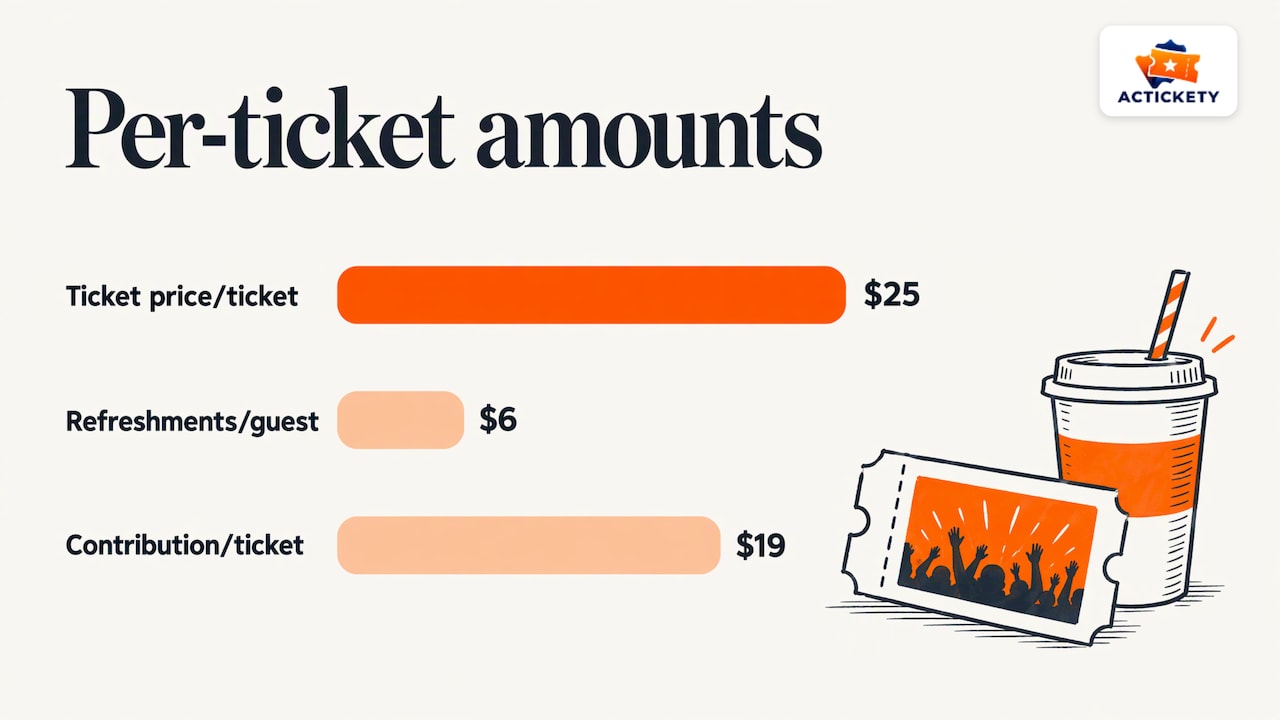
Say a community choir plans a benefit concert. Fixed costs are $2,400 (hall, sound technician, insurance). Variable costs are $6 per guest for light refreshments. Tickets sell at $25.
- Each ticket contributes $19 after refreshments ($25 minus $6).
- Break-even is $2,400 divided by $19, which is about 127 tickets.
Now imagine a ticketing service takes a platform fee on each sale. Every dollar of fee reduces that $19 contribution and pushes break-even higher. If the fee is zero, as it is for ticket sales on Actickety, the break-even stays at 127. Scenario-plan at three levels (cautious, expected, strong) so you know in advance what a slow sales month means for the budget.
For the Southland guide, the expenditure categories to list are venue, equipment, staffing, marketing, logistics, permits, food and beverage, safety, attendee experience and technology. Income may come from ticket sales, sponsorship, grants, vendor fees and donations. Writing all of these down, even roughly, shows you where the money goes.
Track estimates against actuals
Keep one shared spreadsheet with three columns: estimate, quote, actual. Update it whenever an invoice arrives, not at the end. If you manage several moving parts across a team, project management tools for event planners can keep tasks and deadlines next to the numbers.
Spend on the moments people remember
Cutting evenly across every line makes the whole event feel cheaper. Cutting selectively does not. Meetings Today quotes an FCM Meetings & Events executive who says attendees remember meaningful moments rather than line items. The same piece suggests protecting strong content, seamless production, curated networking and personalized welcomes, while trimming low-impact sessions, décor, signage and printed materials.
MPI contributor Devon Pasha makes a similar argument: align spending with the goals of the event design, reduce production that few people notice, and redirect money toward experiences that reach more people.
To apply this, write your event's one-sentence purpose. A charity gala exists to raise money and thank donors. A school open day exists to convince families. A club tournament exists to give competitors a well-run day. Then score every budget line: does it serve that sentence?
What to prioritize
A Northstar Meetings Group guide lists the areas worth protecting: quality programming, strong speakers, smooth registration, clear communication, technology, quality meals and networking. For most small events, the entry experience is the cheapest of these to get right. A clear event page, easy checkout and a quick door process cost very little and set the tone for the whole day.
What to reduce or remove
The same guide points to décor, giveaways, elaborate staging and promotional materials that do not improve the attendee experience. Practical swaps:
- Replace printed programs with a page on your event site or a QR code at the door.
- Replace branded giveaways with one useful item, or none.
- Replace elaborate staging with good lighting on a simple stage.
- Replace a long agenda with a tighter one. PCMA guidance suggests removing repetitive or low-value program content so every minute earns its place, and notes that shorter events can lower attendees' own hotel and meal costs too.
If you need photos or video of the day for future promotion, hire for a short, focused window rather than full-day coverage. A photographer who works in a candid style, as described in this guide to corporate event photography, can capture the moments that matter without a large production crew.
Lower venue and supplier costs
Venue, accommodation and catering are usually the largest lines. MPI contributors recommend four moves worth copying:
- Consider secondary cities or less fashionable areas. Venue, accommodation and service costs are often lower. For a local event, this means looking one neighborhood or town over from the obvious choice.
- Book off season. Weekday evenings, shoulder months and non-holiday weekends tend to cost less than peak dates.
- Negotiate food and beverage pricing inside the venue contract. Do this before you sign, when you still have leverage.
- Bundle work with vendors. Offering several jobs to one supplier gives you grounds to ask for a discount.
Get at least three quotes for each major line, and ask each supplier to itemize. An itemized quote shows what is negotiable. If a venue bundles chairs, tables and cleaning into one fee, ask what happens to the price if you handle setup with volunteers.
Check what your event actually needs
Small organizers often pay for features they never use: reserved seating charts for a standing show, multi-tier registration for a single-price workshop. If you are unsure whether you need ticketing or simple sign-up, our guide to event registration versus ticketing walks through the difference.
When virtual or hybrid cuts costs
Going online can save a great deal when the audience is geographically scattered and the format suits it. In an academic case study of an international scientific meeting moved online, the event cost 4% of what comparable in-person meetings cost. The authors note that the organizers used off-the-shelf software, received grant subsidies and did not charge for their own time, so treat 4% as the best case, not a forecast.
For a workshop, a creator Q&A or a fundraiser with supporters in different cities, a virtual option can remove venue and catering costs for part of the audience. The SIGCHI guide for hybrid organizers stresses that a good hybrid event creates meaningful connections between remote and on-site attendees, so plan how online guests will take part rather than just watch. If you sell online access, see our notes on virtual event ticketing for how fees and access work.
The cost most organizers never question: ticketing
Venue and catering get negotiated. Ticketing usually gets accepted. Many ticketing services charge a platform fee on every ticket, either passed to the buyer or taken from your revenue. On a $25 ticket, even a modest percentage plus a flat charge adds up over hundreds of sales, and it is money that could have funded your cause, your band or your next event.
This is where a different type of tool changes the arithmetic. Actickety lets organizers build an event microsite in ten straightforward steps, generate an AI poster, and set up ticketing and merchandise, all without upfront costs until the event goes live. Unlike the large ticketing marketplaces, there are no platform fees for ticket sales, and you keep 100% ownership of your event data.
That last point has a cost angle too. Your attendee list is the cheapest marketing channel you will ever have. When you own it, you can invite last year's guests back directly instead of paying to reach them again.
Two more savings come from consolidating:
- Website and poster in one place. Building your own event site and poster inside the same platform means you need fewer separate design and web subscriptions. Our guide to creating an event website that sells tickets covers the setup.
- Merchandise alongside tickets. Selling T-shirts, programs or add-ons through the same event page adds revenue without another storefront.
If you are comparing options, how to choose a ticketing platform lays out the questions to ask about fees, data and setup. For step-by-step selling, see how to sell event tickets online.
Ticketing savings by event type
| Organizer | Where ticketing costs bite | What to look for |
|---|---|---|
| Charity fundraiser | Fees reduce the amount raised per guest | No platform fees on ticket sales, fundraising ticketing |
| Musician or creator | Small crowds, thin margins | Own your fan data, simple page, creator ticketing |
| Community group or club | Volunteers, tiny budget | Launch quickly, no upfront cost, community ticketing |
| Festival or multi-day event | Many pass types | Passes set up in one place, multi-day ticketing |
| School or university open event | Limited budgets, many events a year | Reusable setup, free to build |
Control attendance, cancellations and last-minute spending
Surprises are expensive. MPI recommends keeping your venue updated on registration pace, ideally every two weeks, and holding back at least 10% of the budget for last-minute needs. One contributor also suggests taking 15% off the top for planning.
In practice:
- Share sales numbers with the venue and caterer. Catering counts are often guaranteed a few days ahead. Accurate numbers prevent paying for food nobody eats.
- Set a ticket cap that matches your space. Limiting tickets avoids overcrowding, extra security and last-minute capacity problems.
- Know your cancellation deadlines. Put every supplier's deadline in your budget sheet, so you can reduce an order before it becomes a charge.
- Keep the reserve untouched until the final week. If you have not used it by then, you have a surplus.
Scope creep is the other quiet cost: a small addition here, a tweak there. Writing down what is included in each supplier agreement helps, and so does this advice on how to prevent scope creep before it costs you money.
Pay an event planner only for what you need
MPI's October 2025 article explains that a detailed resource plan, itemizing tasks and the time each takes, shows clients where a management fee applies and lets them take on some roles to reduce cost. Ask any planner for that breakdown. Then decide which tasks (for example, ticket sales and your event page) you can run yourself with a simple tool.
Measure value, not only profit
After the event, compare actuals to budget, but do not stop there. A credit union association leader quoted by Northstar Meetings Group says budget evaluation should consider the value to attendees or members and whether the event achieved its purpose, not only whether it made a profit. Keep your purpose sentence handy and ask whether the event delivered it. Next year's budget starts there.
Perspective
Most advice on cutting event costs stops at the venue and the catering. We think the bigger leak is how organizers sell tickets.
When you run a fundraiser, a gig or a club tournament, every dollar that leaves in platform fees is a dollar that did not reach your cause, your artists or your members. We built Actickety around that idea: your event, your revenue, your rules. You build a professional event microsite, create a poster with AI, and set up tickets and merchandise without paying upfront. There are no platform fees on ticket sales, and the data about your crowd stays yours.
Cutting costs should not mean making your event look smaller. It should mean spending on the people in the room, and keeping more of what they pay you.
Tim
Build your event page without upfront costs
If you are ready to turn this budget into a live event, Actickety lets you set up your microsite, poster, tickets and merchandise for free and pay nothing until you go live. You keep ownership of your event data, and there are no platform fees for ticket sales. Start at actickety.com.

FAQ
How do I plan the budget for an event?
List every expected expense and every income source, get supplier quotes, and split fixed costs from variable ones. Then calculate how many tickets you need to sell to break even, and plan for slow, expected and strong sales. Add a contingency of at least 10% for last-minute needs.
What event expenses can I cut without guests noticing?
Décor, giveaways, printed materials, elaborate staging and low-value agenda items are the usual candidates, according to the guidance above. Redirect that money to content, a smooth entry process and a warm welcome, which people remember.
How can a small organizer lower ticketing costs?
Look closely at fees per ticket, not just the headline price of a platform. Actickety is free to set up, asks for nothing upfront until you go live, and charges no platform fees on ticket sales. That keeps more of each ticket in your budget.
Is a virtual or hybrid event always cheaper?
Not automatically, but it can lower venue, catering and travel costs when your audience is spread out. One academic case study of an online scientific meeting found costs of 4% of comparable in-person meetings, though it relied on free software, grants and unpaid time. Plan how online guests will participate, not just watch.
Sources
- Budgeting, Southland New Zealand event toolkit
- Stretching Every Dollar, Meetings Today
- Dollars and sense, MPI
- Smart Event Budgeting Strategies, Northstar Meetings Group
- Doing more with less, PCMA
- Moving conferences online: lessons learned
- Designing Hybrid Conference Experiences, SIGCHI
- Your budget is the event's blueprint, MPI
- Corporate event photography
- Project management tools for event planners
- Preventing scope creep