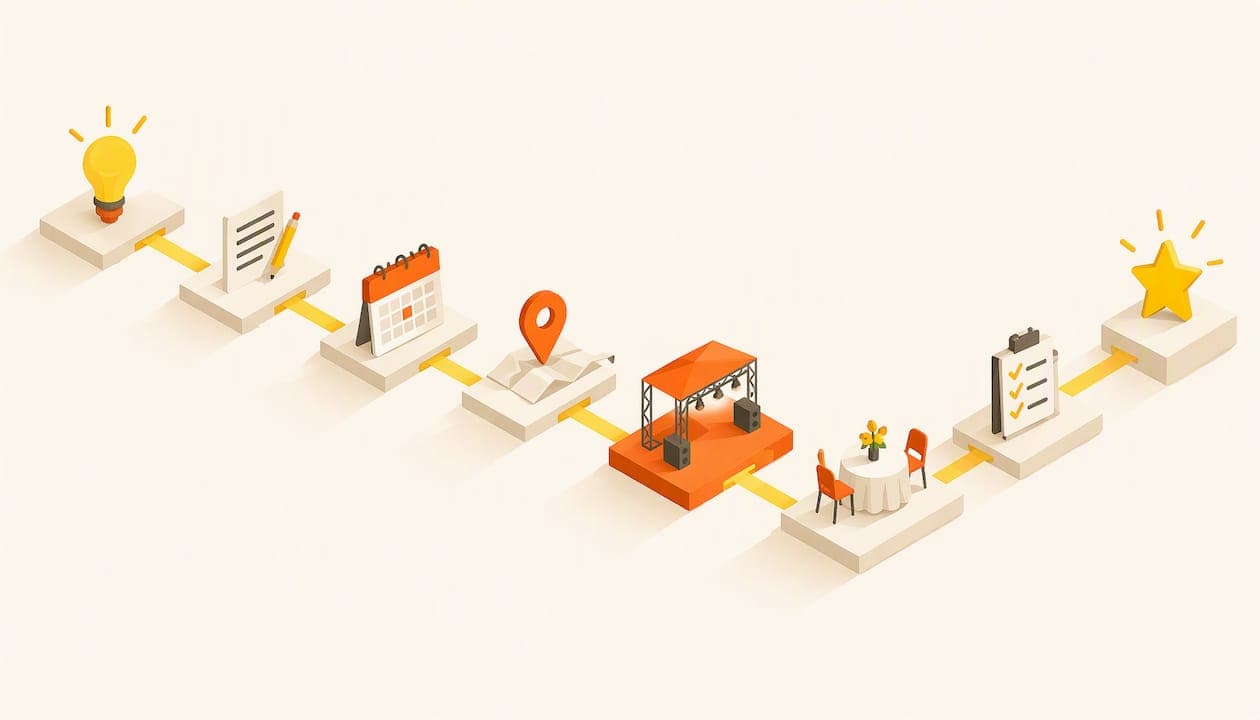
An event planning workflow is a repeatable sequence of steps that takes an event from a rough idea to a closed-out budget. The version below has eight phases, runs backward from your date, and puts dependencies at the center, because that is where most schedules break. It works for a charity gala, a school open day, a club tournament or a 200-seat concert.
TL;DR
- Work in eight phases: goals, team and budget, date and venue, program, ticketing and website, promotion, event day, review.
- Plan backward from the event date and map dependencies early. Late-discovered dependencies hurt more than forgotten tasks.
- Lock scope and budget before you spend money on anything public, such as a venue deposit or printed posters.
- Put ticketing, the event page and promotion on the same timeline as logistics. They are the revenue half of the plan.
- Schedule a 30-minute review within days of the event, and keep the numbers for next time.
Table of Contents
- What a workflow is, and how it differs from a checklist
- The eight phases at a glance
- Phase 1: Define goals and lock the scope
- Phase 2: Organize the team and set the budget
- Phase 3: Choose the date and the venue
- Phase 4: Build the program and book vendors
- Phase 5: Set up ticketing and the event website
- Phase 6: Promote on a schedule, not in bursts
- Phase 7: Run the event day
- Phase 8: Review within a week
- Our perspective: where small teams lose time
- Put phases 5 and 6 on a platform built for small organizers
- FAQ
- Sources
What a workflow is, and how it differs from a checklist
A checklist tells you what to do. A workflow tells you what to do, in what order, who does it, and what has to be finished first. HoneyBook describes a workflow as a documented, repeatable sequence of steps for coordinating an event from start to finish. That "repeatable" part is the point. The second event you run should cost you less time than the first.

The same idea sits behind event project management: treat the event as a small project with a fixed deadline, a budget, a scope and a list of people who each own a piece. You do not need heavy software for that. A shared spreadsheet and a calendar will carry a small event. You need the discipline of writing the sequence down.
The eight phases at a glance
| Phase | Output you should have | Typical lead time (medium event) |
|---|---|---|
| 1. Goals and scope | One-page brief | 6 to 9 months out |
| 2. Team and budget | Roles, budget with contingency | 6 to 9 months out |
| 3. Date and venue | Signed venue agreement | 5 to 8 months out |
| 4. Program and vendors | Run of show draft, vendor contracts | 3 to 6 months out |
| 5. Ticketing and event website | Live page with working checkout | 8 to 12 weeks out |
| 6. Promotion | Campaign calendar | 8 to 12 weeks out |
| 7. Event day | Minute-by-minute schedule | Final week |
| 8. Review | Actuals vs. plan, vendor notes | Within a week after |
Lead times are rules of thumb, not standards. A bake sale needs weeks, a festival needs a year. Scale the column to your event and keep the order.
Phase 1: Define goals and lock the scope
Start with a conversation, then turn it into a document. Abastio's workflow guide opens the same way: every event starts with a vision, a budget range and a date in mind, and the first job is to convert that into a concrete scope before planning begins.
Write a one-page brief that answers:
- Why are we doing this? Raise a set amount for a cause, sell out a room, recruit new members, launch a product.
- Who is it for? Be specific: parents of students, local music fans, alumni.
- What will people do there? Listen, compete, bid, learn, eat.
- When and where, at least as a range.
- How will we know it worked? One or two numbers, such as tickets sold, net revenue, or sign-ups.
If the goal is "a great event", you cannot make trade-offs later. If the goal is "raise $8,000 net from 250 attendees", you can decide quickly whether a pricier venue is worth it.
Phase 2: Organize the team and set the budget
Name an owner for each area: venue, program, ticketing, promotion, volunteers, event-day operations. One person can own several areas at a small event, but every area needs a name next to it.
Then build the budget from both sides:
- Costs: venue, equipment, insurance, permits, food, talent, printing, staff or volunteer expenses.
- Revenue: ticket tiers, merchandise, sponsors, donations, bar or food sales.
- Contingency: hold back a reserve for surprises, and decide in advance who can approve spending from it.
Budgets are under pressure across the industry. In the PCMA 2025 Meetings Market Survey discussion, 60% of planners said they were negotiating harder, 55% were increasing sponsorship opportunities and 53% were cutting non-essential elements. Only about half had raised registration fees. Small organizers can borrow all three moves: negotiate, bring in a sponsor, and cut what attendees will not miss.
A tool can help you keep that budget and the task list in one place. A roundup of project management tools for event planners is a reasonable starting point if a spreadsheet stops being enough.
Phase 3: Choose the date and the venue
Date and venue depend on each other, so decide them together. Check school calendars, holidays, competing local events and your key speakers' or performers' availability before you commit.
Before signing a venue agreement, confirm:
- Capacity at your actual layout (seated, standing, tables), not the brochure maximum.
- What is included: sound, tables, staff, cleaning, parking.
- Cancellation and postponement terms.
- Accessibility: step-free entry, restrooms, seating areas.
- Insurance and permit requirements for your city or campus.
University event offices publish good examples of how this sequence runs in practice. Brown University's planning guide and timeline walks through visualizing, organizing and managing an event step by step. It is written for campus events, but the order carries over to other settings.
Safety and risk
Risk planning belongs here, not in the last week. For larger gatherings, a formal risk-based approach to deciding whether and how to hold the event is the recognized practice. A WHO study of mass gatherings found that 52.3% of recorded gatherings between 2020 and 2023 applied one. For a small event, the practical version is a short written list: what could go wrong, how likely, who responds. Check crowd, fire and medical requirements with your local authority and venue, since they vary by city and state.
Phase 4: Build the program and book vendors
Now design what happens in the room. Start from the goal in phase 1. If networking matters most, build time and space for it. PCMA's 2026 trends piece notes that planners rank peer networking as the most critical element of event success, and that roundtables and hands-on workshops are among the formats that support it. It also quotes expert Julius Solaris on panels, which can be a high-impact, low-effort format when structured for interaction.
Then book vendors against the program:
- Get at least two quotes for large items.
- Put dates, deliverables, payment terms and cancellation conditions in writing.
- Ask each vendor for their load-in time and power or space needs now, not on the day.
Map the dependencies
This is the step that separates a smooth event from a frantic final fortnight. Abastio's guide argues that the most common workflow failure is not a forgotten task but a dependency found too late. Its example: the florist's designs depend on the table layout, which depends on the headcount. If headcount is unknown, three tasks stall quietly.
For each major task, write down:
- What must be finished before it can start.
- Who is waiting on it.
- The date it becomes a problem if still open.
Typical chains for a ticketed event:
- Final headcount depends on ticket sales close date, which drives catering, seating and staffing.
- Poster and social graphics depend on confirmed date, venue name and ticket link.
- Ticket link depends on price decisions, which depend on the budget.
- Run of show depends on performer or speaker confirmations and set lengths.
Phase 5: Set up ticketing and the event website
The event page is where interest turns into revenue, so it deserves its own phase. Many teams treat it as a marketing afterthought and end up promoting a date before there is anywhere to buy.
What to decide and build:
- Ticket types and prices: general, early bird, group, student, VIP. Keep it to a few options.
- Capacity limits matched to the venue layout from phase 3.
- Merchandise or add-ons, if they support the revenue goal.
- One event page with date, place, price, schedule, accessibility information, refund terms and a clear buy button.
- Ownership of your attendee data, so you can email people again for the next event.
Our guides on how to create an event website that sells tickets and on event website design, including accessibility cover the build in detail. If your event is local and volunteer-run, community event ticketing shows how small teams get a ticket page live quickly.
Phase 6: Promote on a schedule, not in bursts
Promotion has its own dependencies: the date, the ticket link and the visuals must exist first. Then work backward from the event date. A common pattern is an 8 to 12 week run:
| When | Focus |
|---|---|
| 10 to 12 weeks out | Announce, open early-bird tickets, brief partners |
| 6 to 8 weeks out | Speaker or performer reveals, partner and sponsor posts |
| 3 to 4 weeks out | Social proof, reminders, price-change deadlines |
| Final 7 days | Logistics emails, last-chance messages, parking and arrival details |
We lay out the full plan in our event marketing plan timeline, and cover the channels in promoting an event online and Instagram event promotion. Email deserves automation from the start: see event email marketing for the six messages worth setting up. For visuals, event poster design explains when AI or a template is enough, and event branding guidelines help keep everything consistent.
Phase 7: Run the event day
The week before, convert the plan into a run of show: a minute-by-minute schedule with a name next to each line. Share it with everyone who touches the event, including volunteers.
A short event-day kit:
- Printed run of show and contact sheet with vendor and venue phone numbers.
- Check-in plan: scanner or printed list, a backup device and a separate line for problems.
- A named decision-maker on site, so staff are not guessing.
- A weather, delay or no-show fallback for the two or three things most likely to go wrong.
- Someone assigned to photos and notes, since you will want both in phase 8.
Sustainability can fit here too. In the same PCMA survey discussion, 60% of respondents said they were including sustainability measures, up from 31% the year before. Simple steps such as digital tickets, reusable signage and sourcing food locally cost little to build into the plan. For a formal framework, ISO 20121:2024 describes sustainable event management systems and notes that a process-based approach lets organizers monitor performance and find ways to reduce resource use and cost over time.
Phase 8: Review within a week
Resist starting the next project right away. Abastio recommends a 30-minute post-event review covering budget accuracy, vendor performance and timeline adherence. Over a few events it becomes your own database of real prices and reliable partners, which is what makes the next plan faster.
Keep the review simple:
- Numbers: tickets sold by tier, revenue, final costs, variance to budget.
- Timeline: which tasks ran late and what they were waiting on.
- Vendors: who was reliable, who was not, what they actually charged.
- Attendees: a short survey or a few replies to a thank-you email.
- Changes: three things to do differently next time, written into your template.
Then turn it into a template. That is all an event workflow template really is: your last event's phases and dependencies, with the dates replaced by offsets from the event date.
Our perspective: where small teams lose time
We see the same pattern again and again among charities, clubs, schools and independent artists. The planning itself is rarely the problem. The problem is that setup is slow and expensive, so the ticket page, the poster and the event site get pushed to the last moment, and then promotion starts late.
Our view is that the revenue half of the workflow should start early and should be cheap to start. Building the event microsite, poster and ticketing before you commit marketing spend lets you test the date, price and message while changes are still easy. It also means the page exists when a sponsor, a venue or a friend asks "where do I buy tickets?"

The second thing we push is data ownership. Your attendee list is the most valuable output of any event, because it makes the next one cheaper to fill. Whatever tools you choose, make sure the list is yours to export and use.
Finally, protect the review step. Teams that skip it repeat the same pricing and vendor mistakes year after year.
— Tim
Put phases 5 and 6 on a platform built for small organizers
If you are an organizer without an agency or a big budget, Actickety is built for exactly this stretch of the workflow. You can build a professional event microsite in ten steps, generate an AI poster, and configure ticketing and merchandise. Setup is free, there are zero upfront costs until you are ready to go live, and you keep 100% ownership of your event data. There are no platform fees on ticket sales. It suits charities, planners, artists, community groups, schools and sports clubs. For options and background on keeping control of your data, see our guide to white label ticketing with no upfront cost.
FAQ
What are the main steps in the event planning process?
The core sequence is: define goals, form the team and budget, choose date and venue, build the program and book vendors, set up ticketing and the event page, promote, run the event, then review. Different guides split these into seven or eight steps, but the order is nearly identical. What matters is that each step has an owner and a due date.
How far in advance should I start planning an event?
It depends on size. A small local event may need 8 to 12 weeks, while a conference or festival often needs six months to a year, mainly because of venue and talent availability. Start from the event date and work backward, putting the longest-lead items, such as venue and key performers, first.
What are the 5 P's of event planning?
The label varies by author, and there is no single official list. A common version covers purpose, people, place, program and promotion. Treat it as a quick memory aid: it maps neatly onto phases 1, 2, 3, 4 and 6 above.
Do I need event project management software?
Not for a small event. A shared spreadsheet with tasks, owners, dependencies and due dates is enough. Consider software when several people edit the plan at once, when you run events repeatedly, or when you need reminders and approvals.
Sources
- Abastio: Event Planning Workflow That Keeps Projects on Track
- HoneyBook: How To Build An Event Planning Workflow That Runs Itself
- PCMA Convene podcast transcript, ep. 58, January 15, 2025
- PCMA: What's Shaping Live Experiences in 2026?
- Bulletin of the World Health Organization: mass gatherings study
- ISO 20121:2024 Event sustainability management systems
- Brown University: Planning Guide and Timeline