A good ticket pricing strategy does three things: it covers your costs at a realistic attendance, it gives different buyers a reason to say yes, and it shows the full price before checkout. Start with your break-even number, build two to four tiers around it, and give every tier a deadline or a cap. The rest of this guide shows how, with worked numbers you can copy.
TL;DR
- Work out your total costs first, then divide by the attendance you can honestly expect. That is your floor, not your price.
- Use two to four tiers (early bird, general, premium), each with a deadline or a limit, so buyers have a reason to commit.
- Show the total price up front. In the U.S., the FTC's fee rule now requires it for live-event tickets.
- Fees and surprises at checkout hurt trust more than a higher honest price does.
- Review sales weekly and adjust the next tier, not the tickets people already bought.
Table of Contents
- Start with your break-even price
- Know what your ticket is worth to the buyer
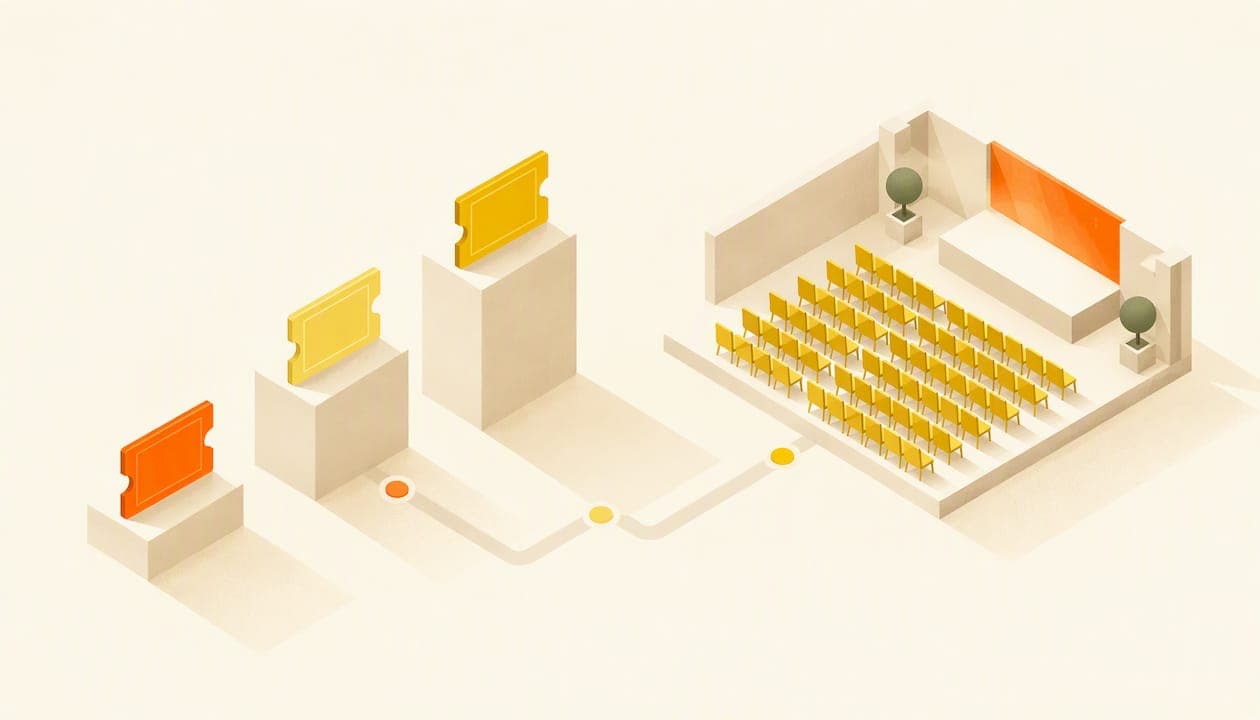
- Build tiers that make sense
- Early bird, regular, last chance: timing the sales window
- Dynamic pricing: powerful, but rarely right for small events
- Show the full price, always
- Our perspective: price the event, not the platform
- Test, track and adjust
- Pricing for specific kinds of events
- Set up your tiers without paying first
- FAQ
- Sources
Start with your break-even price
Before you think about psychology, you need to know what the event costs. Add every cost, fixed and per-person: venue, talent or speakers, sound and lighting, insurance, permits, marketing, staffing, printing, catering, and the fees on card payments. Then add a cushion for the things you forgot. Ten percent is a common starting point, but use your own history if you have it.
Divide the total by the number of paying attendees you expect, not the number the room holds. Comped guests, sponsors' seats and no-shows do not pay.
Worked example. A community concert has $6,000 in total costs and you expect 200 paying guests.
- Break-even price: $6,000 ÷ 200 = $30 per ticket.
- If only 150 people pay, that same $30 ticket brings in $4,500 and you lose $1,500.
That second line is why the floor is only a floor. Run the same math at 75% and 125% of your expected attendance so you know how exposed you are before you publish a price.
Charities and fundraisers: separate cost from donation
If the goal is money raised, not just covering costs, split the ticket in your head. A $60 gala ticket might be $35 of dinner and venue cost plus $25 of contribution. Say so on the ticket page. Donors tend to accept a higher price when they can see where it goes, and it keeps your accounting clean.

Know what your ticket is worth to the buyer
Cost tells you what you need. Value tells you what you can ask. Three inputs help:
- Comparable events nearby. Look at what similar events in your city charge, for a similar length and quality. Do not copy them, but do not ignore them.
- Your audience's budget. Students, families and retirees on a fixed income react to price differently than conference attendees whose employers pay.
- What is included. A $40 ticket with a drink, a program and reserved seating is a different product from a $40 door entry.
One caution from research on sports ticketing: perceived fairness matters as much as the number. A study of price fairness in sport ticket purchase decisions notes the shift from cost-based to demand-based pricing and argues that fairness perceptions can shape whether people buy. A price that looks arbitrary, or far above the face value people remember, can cost you sales even when the market would bear it.
The PwC sports ticketing outlook points the same way: growth depends less on raising base prices and more on reframing the value of a ticket through bundled experiences, loyalty perks and transparent models. For a small organizer, that translates into a simple habit. Raise the perceived value before you raise the price.
Build tiers that make sense
A single flat price treats every buyer the same. The superfan who would pay double and the budget-conscious student see one number. Tiers let you serve both without running separate campaigns.
The three tiers most events need
| Tier | Who it is for | How to limit it | What it does for you |
|---|---|---|---|
| Early bird | Committed fans, people who plan ahead | A date or a quantity (for example the first 60 tickets) | Brings in cash early and proves demand |
| General admission | The bulk of your audience | Opens when early bird closes | Your core revenue at your target price |
| VIP or premium | Superfans, groups, sponsors' guests | A hard cap tied to something physical: seats, access, extras | Raises average revenue per attendee |
A few rules of thumb hold up well:
- Keep it to two to four tiers. More choices slow checkout and blur the differences.
- Leave a clear gap between tiers. If early bird is $25 and general is $26, nobody feels rewarded. A difference of roughly 20 to 40 percent is easier to read.
- Make every tier expire. A tier with no deadline or cap gives nobody a reason to hurry.
- Name tiers by what you get, not just by timing. "Front section" or "Meet the band" says more than "Tier 3."
A worked tier plan
Using the same concert with $6,000 in costs and 200 expected paying guests:
| Tier | Tickets | Price | Revenue |
|---|---|---|---|
| Early bird | 60 | $25 | $1,500 |
| General | 110 | $35 | $3,850 |
| VIP (front section plus a poster) | 30 | $60 | $1,800 |
| Total | 200 | $7,150 |
The same 200 guests at a flat $30 produce $6,000: you break even. With tiers, the average ticket is $35.75 and you clear $1,150. Notice what it takes: the early bird sells out, and 30 people want the premium option. If early bird sells slowly, you learn something early and can adjust before the date.
Check the downside too. If only 150 people come and the mix is the same proportion, revenue is about $5,360, still short. Tiers help, but they do not replace a realistic attendance estimate.
Early bird, regular, last chance: timing the sales window
The usual sequence is early bird, then regular, then a final-weeks price or door price. Early bird works because it rewards people who commit before you have proof the event will sell. The later steps work because they create a deadline.
To set the timing:
- Work backward from the event date. For a local event with a 10 to 12 week promotion window, early bird might run for the first two to three weeks, general for the middle stretch, and a final price for the last two weeks.
- Announce the price change in advance. "Early bird ends Friday" in an email does more than a surprise increase.
- Do not discount at the last minute unless you must. Publicly dropping prices punishes people who bought early. If you have unsold seats, add value (a free drink, an upgrade) or offer a group bundle instead.
If you need a promotion calendar to match your pricing windows, our 8 to 12 week event marketing plan lays out when each push should land, and our guide to promoting an event online covers the channels.
Dynamic pricing: powerful, but rarely right for small events
Dynamic pricing means prices move with demand, sometimes daily or in real time. It is used widely in sports: a paper on demand-based ticket pricing reports that more than two-thirds of Major League Baseball teams were using it in some capacity at the time of writing. A large venue has years of sales data and software that updates prices constantly.
A charity run, a school fair or a 300-seat concert has none of that. You do not have enough history to know the right price in real time, and your audience is often people who know you personally. A price that jumps overnight reads as opportunism. A fixed set of tiers with known dates gives you most of the benefit with none of the backlash.
A reasonable middle path: set your tiers, watch sales, and use what you learn to set the dates and sizes of the next tier or the next event.
Show the full price, always
The quickest way to lose goodwill is a fee that appears at the last step. In the U.S., it is also now a legal risk. The FTC's Rule on Unfair or Deceptive Fees, effective May 12, 2025, covers live-event tickets and requires businesses to tell people the total price they will pay up front. It applies to any business that offers, displays or advertises such tickets, including third-party platforms. If you sell tickets, read the FTC guidance and check with an attorney if your setup is unusual.
Buyers feel this too. Reporting from The Guardian on UK gig-goers cites consumer research from Which? that extra charges can add up to 25% to the final cost of tickets, and that only 35% of consumers say they know about all charges before checkout. That is a UK finding, but the reaction it describes is familiar to anyone who has watched a cart total jump.
What to do about it:
- Quote one all-in price on your event page, your posters and your social posts.
- Decide who pays the fees before you set the price. If you absorb them, build them into the ticket. If you pass them on, show them in the headline price anyway.
- Use plain words at checkout. The same clarity that lifts conversions on a call to action applies to the buy button: say what the buyer gets and what it costs.
Our perspective: price the event, not the platform
We build tools for organizers who are not running stadium tours: charities, school groups, community sports clubs, musicians, workshop hosts. What we hear from them, again and again, is that the ticket price they set is not the price that ends up in their pocket.
Fees skim a slice of every sale. Then a pricing decision that should be about value turns into a calculation of how to hide or pass on charges. We built Actickety so organizers do not face that: we charge no platform fees on ticket sales, you pay nothing upfront until you are ready to go live, and you keep 100% ownership of your event data. That means the price you choose is the price your audience sees, and the sales history belongs to you. That history is what makes your next event's pricing smarter than this one's.
Our advice, in order:
- Do the break-even math before you fall in love with a number.
- Use tiers with real deadlines, and keep them few.
- Put one honest, all-in price everywhere.
- Keep your own data. Which tier sold fastest, which day brought the spike, which email drove purchases: that is how you stop guessing.
— Tim
Test, track and adjust
You will not get the price perfect the first time. You can get close and improve fast, if you track a few numbers each week:
- Sell-through by tier. Did early bird sell out in days or crawl for weeks? Fast means you may have underpriced it. Slow means the discount, the timing or the promotion needs work.
- Conversion on your ticket page. If many visitors arrive and few buy, test the page and the price presentation before cutting the price.
- Source of sales. Know whether your emails, social posts or posters drove purchases. Our guide to event email marketing shows the six messages worth automating around your tier deadlines.
- Average revenue per attendee. This tells you whether your premium tier is doing its job.
Change the next tier, not the one people already bought. If the first tier sells out in 48 hours, raise the next one modestly or add a small second batch at a higher price. If general admission stalls, add value or a group offer before you discount.
After the event, write down what you learned: the price, the mix of tiers, what sold when, and attendance against expectation. Next year's break-even calculation starts from facts.
Pricing for specific kinds of events
Concerts and shows. Seat location is the natural tier. Add a meet-and-greet or merchandise bundle for the top end. Do not price so high that you narrow the audience you are trying to build; a smaller crowd means less atmosphere and less merchandise revenue.
Workshops and seminars. Price against the outcome. If attendees leave with a skill that earns them money, you can charge more than a leisure event. Offer a small group rate for teams and a discounted price for students.
Fundraisers. Make the donation part explicit. Offer a table or sponsor tier for businesses, and a low-cost entry for supporters who want to help but have limited budgets.
School and university open events. Keep general entry low or free, and put the revenue in extras: merchandise, food, premium seats for performances.
Sports club competitions. Charge participants a registration fee that covers costs and spectators a small entry fee or a donation-based option. Bundles with club merchandise raise the average order.
Set up your tiers without paying first
If you want to put this into practice, Actickety lets you build an event microsite, create a poster, and configure tickets and merchandise in ten steps. You pay nothing upfront until you go live, and ticket sales carry no platform fee from us. That makes it simple to test a three-tier plan before committing. For more on the setup side, see our guide to community event ticketing.
FAQ
How do I decide how much to charge for event tickets?
Add up all your costs, divide by the number of paying guests you realistically expect, and treat the result as your minimum. Then compare it with similar local events and with what your audience can afford. If your minimum is far above what comparable events charge, add value to the ticket or lower your costs.
How many ticket tiers should I offer?
Two to four is enough for most events. A common pattern is early bird, general admission and a premium tier. Each should have a clear difference in what it includes and a deadline or a cap.
Should I use early bird pricing?
Usually yes, if you have a promotion window of several weeks. It brings in cash early, shows you whether demand is there, and gives fans a reason to commit. Limit it by date or quantity, and announce the end date in advance.
Do I have to show fees up front?
For live-event tickets sold in the U.S., the FTC's fee rule, effective May 12, 2025, requires that the total price be disclosed up front. Check the FTC's guidance for the details and ask an attorney if your situation is unusual. Showing one all-in price is also better for trust and conversions.
Is dynamic pricing a good idea for a small event?
Often not. It needs a lot of sales data and can feel unfair to a local audience. Fixed tiers with published dates give you most of the revenue benefit and keep buyers' trust.
Sources
- Examining the Role of Price Fairness in Sport Consumer Ticket Purchase Decisions
- Sports ticketing memberships, the new season ticket: PwC
- Examining Consumer Perceptions of Demand-Based Ticket Pricing in Sport
- The Rule on Unfair or Deceptive Fees: Frequently Asked Questions (FTC)
- Ticket fees: UK gig-goers fight back against new wave of charges (The Guardian)