To set up ticket tiers, decide what separates one tier from the next (time, quantity or perks), give each tier a name, a price, a number of tickets and a closing rule, then tell buyers plainly what happens when a tier ends. Do that before you publish, because changing the rules after tickets are sold is where most organizers lose goodwill. On Actickety you configure ticketing as part of building your event microsite, with no upfront cost until you go live and no platform fees on ticket sales.
TL;DR
- A tier is a version of your ticket with its own price, allotment and rules. Tiers are separated by timing, quantity or what is included.
- Start simple: early bird, general admission, and one premium option. Add group or door tiers only if your event needs them.
- Close each tier on a clear trigger (a date or a count) and say so on the ticket page.
- Decide in advance what you will do if a tier sells out or sales are slow, so you are not improvising mid-campaign.
- Lower prices near the event only as a planned move, never as a surprise to people who already paid.
Table of Contents
- What ticket tiers are and how they differ
- Why tiers work at all
- Step 1: Decide what your tiers are for
- Step 2: Name tiers so buyers understand them instantly
- Step 3: Set quantities that add up to your capacity
- Step 4: Price each step with a purpose
- Step 5: Set release rules and closing triggers
- Step 6: Tell buyers exactly how it works
- Step 7: Plan for sell-outs and slow sales
- Tier ideas by event type
- A pre-launch checklist
- Our perspective
- Build your tiers on your own site
- FAQ
- Sources
What ticket tiers are and how they differ
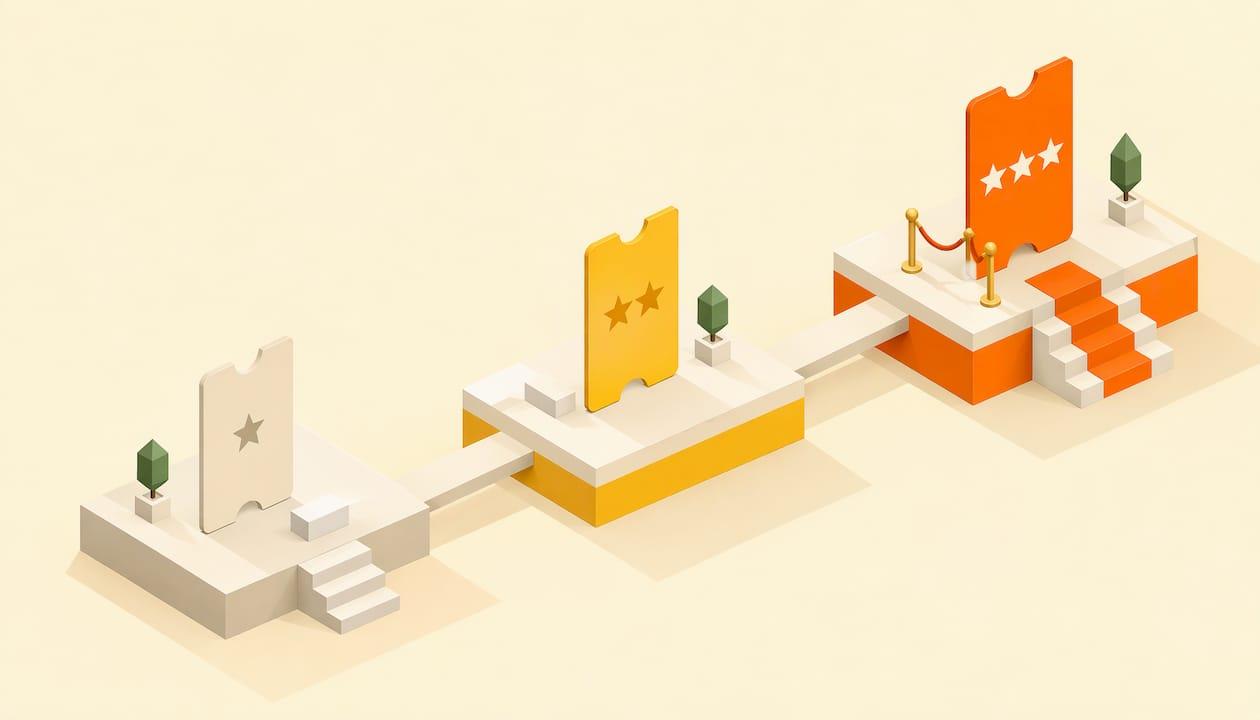
A ticket tier is a group of tickets sold at one price under one set of conditions. When one tier is used up or expires, the next opens, usually at a higher price. The cheapest tier is the one furthest from the event, which is why buyers on concert forums describe "tier 1" as the early, lowest-priced release.
There are two ways to move from one tier to the next, and a third way to differentiate tickets without any sequence at all.
| Type | What triggers the next tier | Best for | Watch out for |
|---|---|---|---|
| Time-based | A date passes | Events with a long selling window, such as a festival or conference | A flat sales curve in the middle weeks |
| Quantity-based | A set number of tickets sells | Events with fixed capacity, such as a concert or gala | Selling out tier 1 in an hour and leaving later fans feeling shut out |
| Benefit-based | Nothing: tiers sit side by side | Events with distinct experiences, such as VIP, workshop plus lunch, or a table | Perks that are not clearly different from general admission |
Many organizers combine them: an early bird tier that ends on a date or when the first 100 tickets are gone, whichever comes first. That one rule protects you from both a slow start and a sudden rush.
Why tiers work at all
Tiers solve two problems at once. They reward people who commit early, which gives you cash and a head count while you can still adjust your marketing. They also let people who want more (a better seat, backstage access, a meal) pay for it instead of you pricing everyone at the same middle number.
The pricing research is clear that organizers have more than one option. An academic paper on pricing for one-time entertainment events describes the policies used most in practice as constant pricing, with one price all season, and two-market pricing, with a regular market plus a last-minute market where the last-minute price can be a markup or a markdown. Dynamic pricing, varying continuously, is a third. For a community event or small concert, tiers are a practical middle path: they give you structure without needing constant monitoring.

If you want the wider logic of choosing the numbers themselves, our guide to ticket pricing strategy goes deeper. This article is about the setup.
Step 1: Decide what your tiers are for
Write one sentence per tier saying why it exists. If you cannot, you do not need that tier.
- Early bird: to bring in committed buyers and fund early costs.
- General admission: the standard price most people will pay.
- VIP or premium: to sell a better experience to people who value it.
- Group: to turn one buyer into several attendees.
- Door or last-minute: to catch late deciders, if you want to sell at the door at all.
A school open day, a charity dinner and a five-band local show need different mixes. A fundraiser often leans on tables and premium seats; a sports club competition may need only spectator and participant tickets. Start with the smallest set that fits your event. Three tiers are easier for buyers to compare than six.
Step 2: Name tiers so buyers understand them instantly
Names do the explaining on your ticket page. Good names say either the timing or the benefit, not an internal code.
- Clear: "Early Bird (first 100)", "General Admission", "VIP with front-row seating", "Table for 6".
- Unclear: "Tier 2", "Package B", "Silver".
If the tier is limited, put the limit in the name or the first line of its description. People act on scarcity only when they believe it, and a visible count or end date is more believable than a vague "limited tickets".
Step 3: Set quantities that add up to your capacity

Start from your venue capacity or your break-even number, then divide. A common mistake is allotting each tier without checking the total, so the sum exceeds what the room holds or what your insurance allows.
A worked example for a 300-seat benefit concert:
| Tier | Tickets | Price | Revenue if sold out |
|---|---|---|---|
| Early Bird | 75 | $20 | $1,500 |
| General Admission | 150 | $28 | $4,200 |
| VIP (front rows plus meet-and-greet) | 40 | $55 | $2,200 |
| Group of 5 (per group) | 7 groups, 35 tickets | $120 | $840 |
| Total | 300 | $8,740 |
The prices here are illustrations, not recommendations. What matters is the method: allocate tickets to add up to capacity, then check that the full-house revenue clears your costs with room to spare. Also check the likely mix. If you expect only half of early bird and general admission to sell, does the event still work? Run that scenario before you publish.
Step 4: Price each step with a purpose
The gap between tiers is a message. A tiny gap, such as $1, gives buyers no reason to act early. A huge gap can feel punishing to people who found out late. Many organizers settle on an early tier that is noticeably, but not dramatically, below the general price, and a premium tier priced for the added experience instead of as a multiple of the base ticket.
To see how to price and time the first tier specifically, read our guide to early bird ticketing. If you are unsure whether your early tier is the right size, testing ticket tiers before cutting prices is a better first move than discounting everything.
For each tier, check three things:
- Does the price cover its share of costs? Include any fees that apply.
- Is the difference to the next tier obvious? A buyer should be able to say in one breath why VIP costs more.
- Would you be happy if every ticket in this tier sold? If not, shrink the tier.
Fees matter here. Because we charge no platform fees on ticket sales, the price you set is the price you plan around. If you are comparing options, ticketing platform fees explained shows what to look for in the totals.
Step 5: Set release rules and closing triggers
Every tier needs a start and an end. Decide each of these before you publish:
- When it opens. Early bird usually opens with your announcement, with later tiers opening automatically after the previous one closes.
- What closes it. A date, a count, or whichever comes first.
- What happens to unsold tickets. Do they roll into the next tier, disappear, or go to a different group, such as members or students?
- Whether tiers overlap. Benefit-based tiers like VIP generally run alongside the others and stay open until sold out.
Put your selling calendar next to your marketing calendar. If you plan a social push in week three, schedule the price step to land just after it, not before, so the push has a price to point at. A few project management tools for event planners can help you keep these dates visible to the whole team.
When you set a date, do not write a specific deadline into evergreen materials such as printed flyers unless that is the only place it appears. Put the live deadline on the ticket page, where you can see and control it.
Step 6: Tell buyers exactly how it works
The tier structure is only as good as how people understand it. On the ticket page, show:
- The name, price and what is included for each tier.
- What closes the tier (date or count).
- The next price, if you are comfortable showing it. Seeing that general admission is higher is the nudge that moves hesitant buyers.
- Refund and transfer terms, stated once and clearly.
On posters and social posts, lead with the tier that is currently on sale and its end point. This is where an eye-catching poster helps: the offer is the headline, not the small print. Actickety includes AI poster generation alongside the microsite, so the poster and the ticket page can carry the same tier names and prices.
Keep your messaging consistent across channels. A post that says "$20 early bird" after that tier has closed is the fastest way to create refund requests and bad reviews.
Step 7: Plan for sell-outs and slow sales
When a tier sells out early
This is a good problem, but handle it with intent. Options:
- Let the next tier open as planned and say so. Buyers who missed out understand a price step more readily than silence.
- Add a small, clearly labeled extra allotment only if capacity truly allows it. Do not recreate the cheap tier under a new name.
- Collect interest for later releases by pointing visitors to your newsletter or social channels.
When sales are slow
Before you cut prices, diagnose. Slow sales can mean low awareness, a wrong price, or an unclear offer. Check where visitors drop off: if people view the ticket page but do not buy, look at the price and the tier descriptions. If few people visit, that is a marketing problem and a discount will not fix it.
Targeted moves usually work better than a blanket cut:
- Add a group tier for clubs, classes or teams.
- Bundle a benefit, such as a drink or merchandise item, with general admission.
- Extend the early bird by a short, announced period if it was your only sub-goal.
Should prices drop close to the event?
Sometimes, but plan it. A University of Maryland working paper on baseball resale found that ticket prices fell significantly as the game approached, with four price measures dropping by 46 to 50 percent of face value in the final month. That is a resale market with many individual sellers, not a single organizer's box office, and it shows that last-minute demand tends to hinge on price. If you choose a last-minute markdown, announce it as part of the structure from the start, such as a clearly labeled day-of tier, so earlier buyers are not surprised. A planned tier feels like a policy. An unplanned cut feels like an apology.
Tier ideas by event type
| Event | Suggested tiers | Why |
|---|---|---|
| Local concert | Early bird, general, VIP front-row | Fans commit early; a few pay for access |
| Charity dinner | Individual seat, table of 8, sponsor table | Tables bring in groups and donors |
| Workshop or seminar | Early registration, standard, with materials | Small capacity, so a count-based close works well |
| School or university open event | Student, general, family pack | Price by audience, not by date |
| Festival | Early bird, standard, VIP, day pass | Multi-day structure needs clear pass types; see multi-day event ticketing |
| Online creator live show | Early, general, meet-and-greet | Premium experiences sell to a loyal audience |
| Sports club competition | Spectator, participant, team entry | Different roles, not different times |
For a fundraiser in particular, tiers can carry the cause: a ticket that includes a donation, or a sponsor table. Our guide to fundraising event ticketing covers that in more detail.
A pre-launch checklist
- Tier quantities add up to capacity.
- Full-house and half-house revenue both clear your costs.
- Each tier has a clear name, price and description.
- Each tier has a defined start and closing trigger.
- The ticket page explains the tiers, refunds and transfers.
- Posters and posts use the same names and prices as the ticket page.
- You know what you will do if tier 1 sells out in a day, and what you will do if it has barely moved by the halfway point.
Our perspective
Most organizers we talk to think of ticket tiers as a pricing trick. We think of them as a promise to your audience: this is what you get, this is when it changes, and this is what it costs. When the promise is clear, people buy sooner and argue less.
That is why we built Actickety around the idea that you should control the whole picture. You build your microsite in ten straightforward steps, set up ticketing and merchandise, and keep 100% of your event data. There is no upfront cost until you are ready to go live, and no platform fees on ticket sales, so every tier you design is worth what you priced it at.
Your event. Your revenue. Your rules. Tiers are one of the best ways to put that into practice.
Tim
Build your tiers on your own site
Actickety lets you create a professional event microsite, generate an AI poster and set up ticketing and merchandise for free, paying nothing upfront until you go live. There are no platform fees on ticket sales, and you keep full ownership of your event data. If you are ready to turn your tier plan into a live ticket page, start at actickety.com. To see the full process first, read how to sell event tickets online, step by step.

FAQ
What does tier 1 and tier 2 mean for concert tickets?
Tiers are release stages. Tier 1 is normally the first and cheapest batch, and tier 2 opens at a higher price once tier 1 sells out or its date passes. The names are just labels, so spell out the price and the closing rule on the ticket page.
How many ticket tiers should I offer?
For most community events, three is plenty: an early bird, a standard ticket and one premium or group option. More tiers mean more explaining and more ways for buyers to get confused. Add a tier only when you can state in one sentence why it exists.
Should tiers close by date or by quantity?
Use both when you can, with the tier ending at whichever comes first. A date keeps the campaign moving if sales are slow. A quantity cap protects your price if demand is strong. Show whichever limit is more likely to apply as the headline.
Do ticket prices drop right before the event?
They can, especially in resale markets, where research on baseball tickets found steep declines in the final month. For your own box office, make any last-minute price a planned tier that you announce from the start, so early buyers see it as part of the structure, not a reversal.
Sources
- Optimal pricing and advertising policies for a one-time entertainment event, ScienceDirect (2019)
- Dynamic Pricing Behavior in Perishable Goods Markets, University of Maryland
- 7 Best Project Management Tools for Event Planners in 2026