Early bird ticketing means selling a limited block of tickets at a lower price before the standard price begins. The discount rewards people who commit early. In return, you get cash and a read on demand weeks or months before the event. Early bird tickets are not more expensive than regular ones. They are the cheapest tier, and they end at a set date, a set quantity, or both.
This guide shows how to build an early bird offer that works for a small or mid-sized event: how deep the discount should go, how long it should run, how it fits with other ticket tiers, and how to tell afterward whether it helped.
TL;DR
- An early bird ticket is the first tier of a time-based price ladder: early bird, standard, then late or door. Same access, lower price for earlier commitment.
- Keep the discount meaningful but modest. We suggest starting around 15% to 25% off and testing from there, rather than slashing prices.
- Close the tier with a date, a quantity cap, or both, and say exactly which one in every message.
- Track registrations by week, tier mix and average price per ticket to see whether the offer added sales or only discounted ones you would have made anyway.
- Pick a setup where you control the tiers yourself and pay no platform fee on ticket sales.
Table of Contents
- What early bird ticketing actually is
- Why it works for organizers
- How tiered pricing and early bird work together
- How big should the discount be?
- How long should an early bird last?
- Setting up your tiers step by step
- Promoting the offer without cheapening it
- Our perspective
- How to tell whether it worked
- Common mistakes
- Early bird for different event types
- Set up early bird tiers with Actickety
- FAQ
- Sources
What early bird ticketing actually is
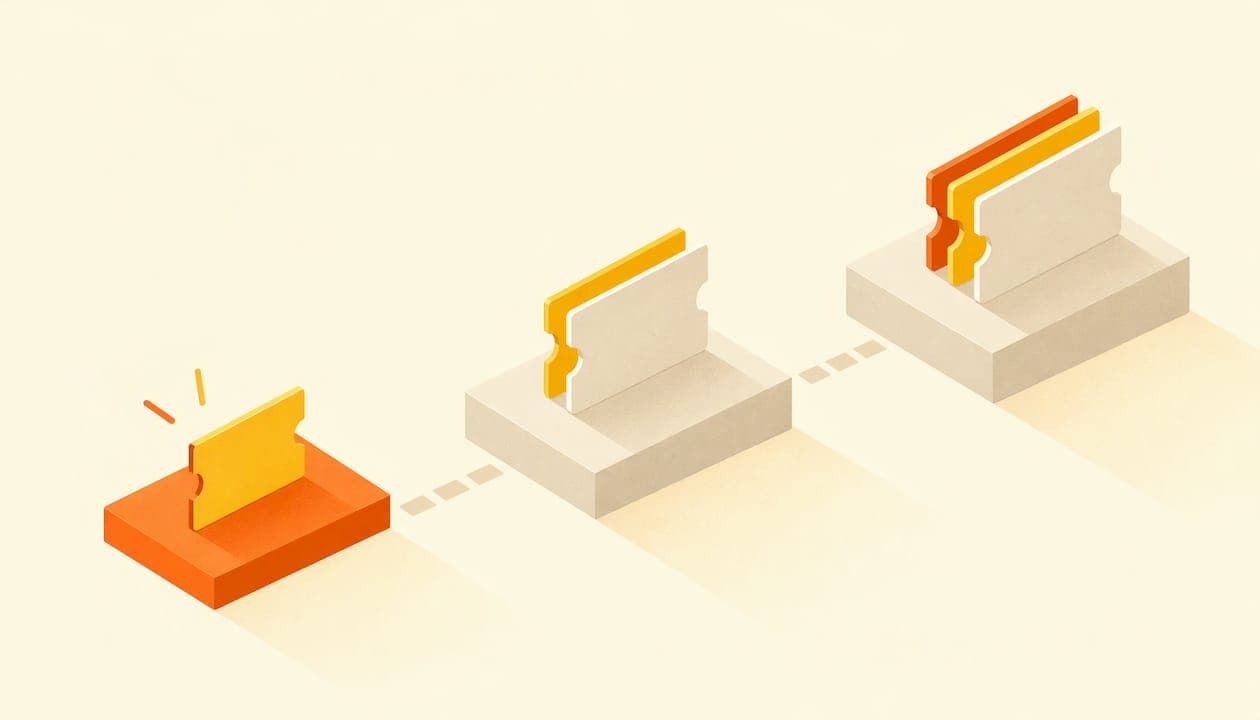
Picture three price points for one event. The first is a limited early bird price. The second is the standard price, which runs for most of the sales period. The third is a late or on-the-door price. Early bird is simply the first rung.
The buyer gets the same seat, the same workshop place or the same festival entry. What changes is when they decide. The organizer is trading a slightly lower price for certainty: a committed buyer, early money, and a signal about how the event is selling.
Three things define a real early bird offer:
- A lower price than the standard ticket, large enough that buyers notice.
- A clear end: a date, a number of tickets, or whichever comes first.
- The same product. If early buyers get less, you have a different ticket, not an early bird.
Are early bird tickets more expensive?
No. The name comes from the saying about the early bird catching the worm, and the ticket works the same way: the earliest buyers get the best price. If you see a price that rises as the event approaches, that is the early bird tier ending and the standard tier taking over.
There is one honest caveat for buyers. Demand-driven resale and dynamic pricing can move in either direction. A StubHub analysis found that fans who waited until the day of the event paid 30% less on average than buyers a month earlier. That was resale of sold-out and surplus inventory, not organizer-set early bird pricing. It does show why your early bird needs a firm deadline and a visible reason to act: if buyers believe prices will fall, they wait.
Why it works for organizers
Early bird pricing does several jobs at once.
- Early cash. Deposits for venues, equipment, artists and printing are due long before doors open. Early sales cover some of that.
- Demand signal. If your early bird block sells slowly, you learn in week three, not week eleven, and you still have time to change your marketing.
- A real deadline. Most people postpone decisions. A closing date turns "maybe later" into "today."
- A reason to post. "Early bird ends Friday" gives you a fresh, honest message to send without sounding repetitive.
- Committed attendees. People who have paid are far more likely to show up, share the event and bring friends.
For charities, clubs and community groups, the first point often matters most. A fundraising dinner or a school open day has fixed costs, and a base of early sales takes the pressure off.
How tiered pricing and early bird work together
Early bird is one kind of tier, the time-based kind. Tiered ticket pricing also lets you split prices by audience or by access level:
| Tier type | What changes | Example |
|---|---|---|
| Time-based | The date you buy | Early bird, standard, last chance |
| Audience-based | Who you are | Student, member, group of four |
| Access-based | What you get | General, VIP, ticket plus merchandise bundle |
The tiers stack. You might run a general admission ticket with an early bird price, a student ticket at a fixed lower price, and a VIP ticket that is never discounted. The key is to keep the logic easy to explain in one sentence. If a buyer needs a chart to understand your pricing, many will simply leave.
We cover the wider question of how to set the base price in our guide to ticket pricing strategy, and a closer look at testing tiers before you cut prices in our piece on early bird pricing.
How big should the discount be?
There is no universal number, and anyone who gives you one as law is guessing. What we see organizers use most often is a discount in the low-to-mid range: roughly 15% to 25% off the standard price. Our reasoning:
- Too small (under about 10%) and the saving feels like a rounding error. Nobody changes their behavior for it.
- Too large (say 40% or more) and the standard price starts to look inflated. Buyers learn to wait for the next discount, and early bird buyers feel less special once everyone gets the deal.
A useful test is to convert the discount into a concrete thing. On a $40 ticket, 20% off is $8, about the cost of a drink or a parking fee. If that sounds like a real saving to your audience, the discount is probably right. If your tickets are $15, a 20% discount is $3, and you may do better with a round number such as $12 for early bird and $15 standard, which is easy to read at a glance.
A worked example
Say you run a one-day workshop with 120 places and a $60 standard ticket.
| Tier | Price | Tickets | When it ends | Revenue if sold out |
|---|---|---|---|---|
| Early bird | $48 | 30 | Eight weeks before, or when sold out | $1,440 |
| Standard | $60 | 70 | Two weeks before | $4,200 |
| Late | $70 | 20 | Event day | $1,400 |
The total if everything sells is $7,040. Compare that with selling all 120 at $60, which is $7,200. The early bird tier costs you $160 in the best case, and in exchange you get 30 committed buyers early and a read on demand. That is the real math to run: the cost of the discount against the value of the earlier certainty. If the late tier does not sell, or sells at the standard price, your numbers shift, so plan for the version of events you think is most likely.
To build the same kind of forecast for your own event, a spreadsheet works well. This profitability and pricing analysis template is one way to model what each tier does to margin across the sales period.

How long should an early bird last?
Long enough that your audience can see it, short enough that the deadline feels real. As a rule of thumb we suggest:
- Small local events (a concert, a class, a fundraiser): two to four weeks.
- Larger events with a long sales cycle (a festival, a conference): several weeks up to a couple of months, often as the very first release.
- Anything with a hard capacity: use a quantity cap as well, so the offer can end early if it sells out.
The length should follow your promotion plan. If you will only start posting five weeks before the event, an early bird that closes six weeks out will end before anyone has heard about it. Start from your announcement date and work forward.
Date, quantity, or both
Organizers can close a tier with a date, a ticket cap, or both. Each sends a different message.
- Date only: "Ends Sunday at midnight." Simple, predictable, and good when you do not know how fast tickets will go.
- Quantity only: "First 50 tickets." Creates urgency but gives no end date, so it can drag if sales are slow.
- Both: "First 50 tickets or until Sunday, whichever comes first." This is the cleanest option for most events because it protects your budget on the high side and gives a hard stop on the low side.
Whichever you pick, say it in plain words on the ticket page, in emails and in social posts. Vague terms such as "limited time" invite buyers to wonder whether the deadline is real.
Setting up your tiers step by step
- Set your standard price first. Base it on your costs and what your audience pays for similar events, then work backward to the early bird.
- Choose the early bird quantity. Pick a number you would be glad to sell at the discount. For a first-time event, 20% to 30% of capacity is a reasonable starting block.
- Pick the end condition. Date, cap, or both, as above.
- Plan the later tiers. Decide the standard price window and whether a late price applies. Late prices are optional. Many small events skip them and keep the standard price until the event.
- Write the offer once and reuse it. The same sentence on the ticket page, the poster, the email and the social posts avoids confusion.
- Schedule your reminders. One announcement, one mid-point reminder, one "last 48 hours" message is plenty.
- Check capacity rules. If your venue has a fixed limit, make sure the sum of all tiers does not exceed it.
If you are tracking all the moving parts of an event alongside pricing, a roundup of project management tools for event planners can help you keep deadlines such as tier close dates in one calendar.
Promoting the offer without cheapening it
An early bird price only works if people know about it. A few approaches that keep the offer feeling earned rather than desperate:
- Lead with the date. "Early bird closes Friday" is more compelling than "Save 20%."
- Tell your existing audience first. A mailing list, a club membership or a social following should hear about the early bird before anyone else. Rewarding your most loyal supporters is the entire point.
- Show the price step. Display the standard price struck through next to the early bird price, and state what the next price will be.
- Do not extend casually. If you extend a deadline once, buyers will expect it again. If you must extend, make it a one-time, clearly explained change, such as a lineup announcement.
- Pair it with a story. A new headliner, a confirmed venue, a speaker reveal. Each gives a reason to post and a reason to buy now.
For more ideas, see our list of tactics that increase ticket sales, and if you are selling shows as a solo musician, our guide to independent artist ticketing.
Our perspective
Most organizers we talk to treat early bird as a discount. We treat it as a test. You are asking your audience a question: at this price, how many of you will commit today? The answer is worth more than the discount costs you.
The trouble is that many ticketing tools take a cut of every sale, so a 20% early bird discount comes on top of platform fees and your margin on those first tickets nearly disappears. That is the part we think is backwards. Charities, clubs, artists and community groups work on thin budgets, and they should not have to share their success with a middleman before the doors have even opened.
That is why Actickety is built the way it is: no upfront cost until you go live, no platform fees on ticket sales, and 100% ownership of your event data. You can see who bought early, when, and at what price, and you can use that to plan your next event. Your crowd, your business, your rules.
Tim
How to tell whether it worked
Do not judge an early bird by whether it sold out. Judge it by what it changed. Three numbers are enough:
- Registrations by week. Plot weekly sales from the announcement to the event. A healthy early bird shows a bump at launch and another near the deadline. Then compare with the weeks after the tier closes. If sales fall to almost nothing, you may have pulled demand forward without adding any.
- Tier mix. What share of tickets sold at each tier? If 80% of your sales are early bird, the discount may be too generous or your standard price too high. If only 5% are, the discount is too weak or the promotion too quiet.
- Average price per ticket. Total ticket revenue divided by tickets sold. This is the cleanest measure of what the discount cost you across the whole event.
Then compare against your last comparable event if you have one. Did you sell out earlier? Did you reach break-even sooner? Did total revenue go up or down? A single event is a small sample, so keep notes and adjust slowly: change one thing at a time, such as the discount depth or the length, rather than all of them.
This is also where owning your data pays off. When purchase records live in your own account, you can export them and look at the pattern yourself instead of relying on a dashboard that shows only what the platform wants you to see.
Common mistakes
- Discounting too early and too deeply. You teach buyers to wait.
- No clear end. Without a deadline, there is no early.
- Giving early buyers different access. Changes the product and invites complaints.
- Forgetting fees. If a platform takes a percentage of each ticket, your real net on a discounted ticket is smaller than it looks. Calculate it before you set the price.
- Running the offer when nobody can see it. The best-priced ticket on an unpromoted page sells nothing.
- Changing the rules midstream. Honor what you announced. Trust is the thing you are selling alongside the ticket.
Early bird for different event types
Community and charity events. Use a simple two-tier setup: early bird and standard. Add a table or group ticket if it suits a dinner or quiz night. Our guide to community event ticketing walks through a fast setup.
Music and festivals. A first-release block, a second release, and a final tier is a familiar pattern. Bigger events can add VIP and bundle tiers. See our overview of festival ticketing options.
Workshops, seminars and courses. Early bird works well here because attendees often need to plan travel or time off. A group discount for several attendees from the same company is a natural second tier.
Online creators running in-person events. Your audience already follows you, so a short, well-announced early bird to your list often does most of the work.
Virtual and hybrid events. The same logic applies, though the cost per extra attendee is lower, so the discount mostly affects timing, not margin. See virtual event ticketing.

Set up early bird tiers with Actickety
Actickety lets you build an event microsite, generate a poster with AI, and set up ticketing and merchandise in ten straightforward steps. There is no upfront cost until you are ready to go live, and no platform fees on ticket sales. You keep full control of your event data, so you can see exactly how your early bird performed.

If you want to see how it works, start at Actickety or explore Lumina. If you are building the site first, our guide on how to create an event website that sells tickets covers the page structure that converts. Once tickets are sold, QR codes for tickets make check-in quick.
FAQ
What is the difference between early bird tickets and regular tickets?
The access is the same. The difference is the price and the timing. Early bird tickets are sold first, at a lower price, in limited numbers or for a limited window. Regular tickets go on sale after that closes, at the standard price.
Are early bird tickets more expensive?
No. Early bird tickets are the cheapest tier. If a price goes up as the event gets closer, that is the early bird ending and the standard price starting. Prices on the resale market can behave differently, which is a separate matter from organizer-set early bird pricing.
How long should an early bird sale last?
For small local events, two to four weeks is a sensible starting point. Larger events with a longer sales cycle often run it for several weeks. Start from the date you will begin promoting, and add a ticket cap so the offer can close early if it sells out.
Is it "early bird" or "early-bird"?
Both appear in print. Early bird is the common choice for the noun phrase, as in "early bird tickets," and a hyphen is often added when it works as a single modifier before a noun. What matters most is using one form consistently across your ticket page, emails and posters.